
Warren Previous Residents by Era
A single Warren address can leave footprints in several collections. None of them cover the same years or the same kind of relationship. Recorded instruments form the backbone of any Warren ownership history. Directory and census material, meanwhile, can supply a dated household clue for the very years a deed stays quiet. Permits and maps help date a structure. They also explain how a parcel took its present shape. The wise path starts with the most recent Warren record already tied to the parcel. Then it works toward older sources one step at a time. Confirm each directory volume's year before treating an entry as evidence.
| Source | Period available | Where held | What it can show |
|---|---|---|---|
| Register of Deeds index | Exact earliest online year for Warren research not published | Macomb online service, terminal, staff, or mail | Warren transfers, parties, dates, and legal descriptions |
| Polk and Bresser directories | Polk reaches the late 1800s; Bresser is commonly later | Library of Michigan and participating-library resources | Dated Warren street or household-head listing, where the volume exists |
| Federal census | Released through 1950 | NARA, FamilySearch, and library resources | Warren household snapshot at the census date |
| Building history | Current Warren BS&A history; earliest retention not stated | Warren Building and City route | Warren project, permit, inspection, and date information |
| Sanborn maps | Michigan guide covers 1884 through 1961, with later series | Library of Congress and Library of Michigan | Warren building footprint, use, material, and street context |
Pair the sources deliberately. Use an old Warren transfer or a modern assessment entry to lock down parcel identity, a directory or census page for the historical listing, and maps or permits for the physical story of the land. Be careful with the Macomb civic directory, though. It is not a substitute for a Warren household directory. Its editions from 1947-48 onward describe county offices and services, which can help you identify a Warren agency named in an old record, but the people at a house appear only in a true city directory.
Anchor an Old Warren Address
Start a Warren address-history search by preserving the original wording from the document. Copy it exactly as written. Capture the street number, direction, suffix, unit, and ZIP code. Include any township or village-era label too. Then search Warren BS&A by address and parcel number. Its assessment result can supply a situs, a legal or parcel identifier, values, and characteristics. Sale information may appear as well. An owner or taxpayer relationship can also surface. One caution applies. The tax-roll mailing address may point somewhere else entirely. Never treat it as proof that a person lived at the physical location.
Macomb GIS and Warren Planning supply the geographic check. Parcel geometry, plats, and map layers all help. Lot splits and lot combinations help too. Together they establish whether a modern address sits on the same land unit as an older notation. The Warren parcel number and legal description often outlast a changed street presentation. Warren publishes no comprehensive readdressing year. When a bridge between old and new forms is uncertain, retain both address strings. Ask Warren Planning about the specific parcel. Do not rewrite the older record to match today.
Note: Keep the original Warren address string separate from any normalized search form so a later researcher can see exactly what the dated source said.
Warren Recorder Index Limits
The Macomb County Register of Deeds records Warren deeds, mortgages, liens, lis pendens, federal tax liens, and related instruments. Basic online searching is free. Advanced searching supports address, legal description, parcel ID, and name queries. The office does not publish the oldest year available online. That limit matters for previous-residents work. An older no-result may reflect the online boundary, a book outside the portal, an unindexed image, an alternate name, or indexing work still in progress rather than a true absence.
When the basic result comes up incomplete, use the public terminal or submit a narrow mail or staff request with document type, grantor or grantee names, approximate date, and the Warren address, legal description, or lot. The current search-options page lists staff and mail searches at $5 plus $1 per page. It distinguishes the paid advanced subscription from purchased document images. The office itself warns that an indexing-in-progress marker is not evidence that no document exists. Record the instrument number, date, document type, and indexing status before drawing any conclusion.
Trace the Macomb Deed Chain
A Warren chain of title is simply the sequence of recorded transfers. It covers the same land interest over time. Start with today's parcel or legal description. Then move backward through each seller's earlier acquisition. Follow the legal description, not just the street address. Subdivision changes, plat language, number changes, and boundary shifts can all hide the earlier document. An address-only search may miss it for that reason. Remember what a deed proves. It connects named parties to a recorded transfer on a date. But it does not by itself establish a current or continuous residence.
- Use the current Warren assessment result to record the parcel number, legal description, and the owner or taxpayer field exactly as displayed.
- Find the latest Warren recorded purchase or transfer in the Register of Deeds index and save the instrument number, recording date, document type, grantor, and grantee.
- Search the seller from that Warren transfer as a grantee, then compare the legal description to locate the seller’s earlier acquisition.
- Repeat the Warren transfer-to-prior-acquisition pattern, noting lot, block, subdivision, parcel, and address variations separately.
- When the Warren online trail stops, use the public terminal, staff route, or mail request rather than inventing an online cutoff year.
- Grantor
- The party recorded as transferring an interest in a Warren instrument.
- Grantee
- The party recorded as receiving an interest in a Warren instrument.
- Chain of title
- The dated succession of Warren recorded transfers for a property interest.
- Legal description
- The lot, block, plat, or parcel language that identifies Warren land in a recorded instrument.
For a Warren image or certified-record question, the Register of Deeds offers online purchase, the free public terminal for indexing, and staff or mail copies. A request that cites a document number is far more precise than a broad request for all prior residents of an address.
Note: Keep a separate list of Warren instrument numbers and recording dates so each backward step can be checked at the custodian office.
Warren Previous Residents in Directories
Deeds show ownership. A residents directory shows who lived there. The Library of Michigan describes Polk directory access by surname, street, phone, and classified modes. Bresser and criss-cross volumes suit street work. They list households alphabetically or by house number, and dated editions can carry a first-listed year, relocation note, building listing, phone, or owner notation. Warren coverage varies volume by volume. Confirm each one before relying on it. Most older books also name only the household head, so others at an address go unlisted.
Treat each entry as a dated statement, such as listed at this address in this edition, rather than proof of continuous residence. Keep the edition, page or image, full printed address, and any abbreviation key. The Warren city directory collections explain reading the historical books in depth.
Pair Warren Directories and Census
Federal census records open under the 72-year rule. The 1950 count is the newest release. Pick a directory volume near a census year. Keep the directory's exact address wording. Then compare it with the census image or index without assuming identical street presentation. A changed number can mean a move. A different household head or a missing entry might too. Publisher conventions, skipped editions, and indexing differences explain other gaps. Treat every mismatch as a lead, not a legal event.
The Warren Historical & Genealogical Society keeps local census index runs for 1830-1870, 1870-1890, and 1900-1920. Its other leads cover cemetery, death, church, and diary records, plus street and business indexes. Verify a local index against the underlying census image. The public custodian works as a final check. FamilySearch images, Library of Michigan materials, and the society archive complement each other when one collection lacks the year you need.
Note: Compare two or three dated points in the record trail instead of treating a single directory entry as a continuous address history.
Date a Warren Building
Building records help date work at an address. Read them as project evidence. Warren's BS&A Building route searches by address, name, parcel, or Building Department Record Number. A result may show a permit number, address, parcel number, record type, permit date or status, project description, inspection status, and an applicant or contractor. Older material may sit in retained files. Ask the Warren Building Division about those files, or make a focused request for a nonexempt record.
Sanborn fire-insurance maps tell a different story. The Library of Congress guide explains that a dated edition can show footprints, construction materials, uses, street context, lot relationships, and hazards. Library of Michigan microform guidance covers Michigan maps from 1884 through 1961 and later series. The official sources publish no Warren edition list. Search by city and edition first. Only then claim a map for a particular address. Together, a permit file and a map edition can bracket a building's changes.
Warren Historical Index Leads
The Warren Historical & Genealogical Society index is a strong local starting point for past residents research. Its menu points to local census PDFs, cemetery material, Macomb death records, diaries, church records, and street or business materials. A hit can date an event. It can also separate two similar Warren names. Remember that the society is an archive, not a government records custodian. Check every hit against the image, the original record, or the responsible public office. The archive also supplies the local index display. Warren researchers get real depth here.

Use those categories as leads. Preserve the edition or source date. Cemetery and death material can close a historical trail. A burial record still cannot establish every Warren address where a person lived. Note: A local index narrows the search, while the original image or custodian record remains the source for a final citation.
Compare Warren Archive Contacts
Warren's history sits in many places, spread across city, county, library, and community routes. The City Community Outreach page identifies the Historical Commission gallery at the Warren Community Center and the Bunert School Museum, an 1875 one-room schoolhouse. Both are strong local-history leads. They are not resident rosters, though. Check holdings and appointment details directly before a visit. The Community Outreach page also supplies this Warren historical-community display.
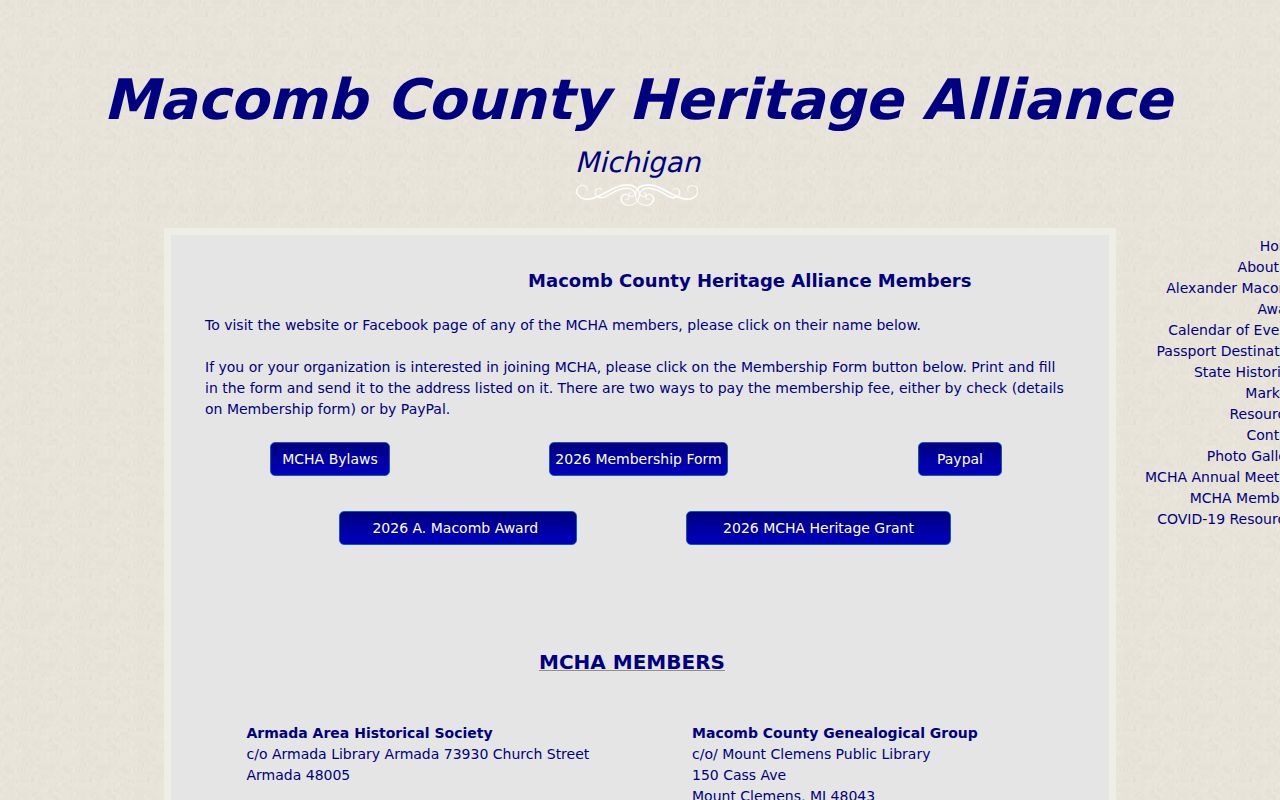
The Macomb County Heritage Alliance member listing adds contact leads. It covers the Warren Historical & Genealogical Society. It also covers the Warren Historical Commission, Macomb County Historical Society, and Macomb County Genealogical Group. It lists organizations. It is a directory of organizations, not a list of residents or members by address.
Archive contacts work for leads, dates, and access methods. A certified or current record still comes from the governmental custodian.
Warren Past Resident Boundaries
No Warren past residents search can rebuild a full household roster for a single address. Each record type answers only part of the question. A deed names the parties who transferred the property. Assessment rolls label an owner or taxpayer. A permit attaches a name to a role. Directories and census listings are date-bound snapshots. Utility customer files, private delivery data, and DMV addresses never form an open address history. The same goes for protected court material. The identities of other household members never do either. A gap is just a gap. It is not evidence that a person or record never existed.
Genealogy records at Macomb can be inspected Tuesday through Thursday mornings for eligible county material. The local page applies a general 100-year inspection rule. Death-index windows run 1867 to 1933. Records from 1934 through 1958 sit offsite. Later records can be verified by a deputy clerk rather than opened for viewing. Michigan statute sets its own clocks. It allows 75 years for death, marriage, and divorce records. Births stay closed for 110 years. Custody matters, and so does access mode. Ask the Macomb County Clerk or Michigan MDHHS which route applies before you order a record.
Lawful use. Use Warren past-resident material for family history, house history, estate questions, or a dated personal record trail. Do not use it to stalk, harass, intimidate, or harm anyone.