
Warren City Directory Collections
Warren directory research draws on more than one kind of book, and the differences matter. The Library of Michigan treats Polk volumes as residential research tools. Bresser or criss-cross volumes are held there the same way. Macomb County's archive, meanwhile, holds civic directories. These formats do different jobs. Polk holdings at the Library reach back into the late 1800s. The exact Warren run within that collection is not pinned down on the title lists. Bresser material tends to be later, often from the late 1960s onward. Its Warren coverage also varies by volume. Before leaning on any book, check its title page. Look for the city coverage it actually claims.
That distinction should shape how a Warren search proceeds. A Polk or Bresser volume gives a dated name or street lead. A Macomb civic book instead reveals which county office, municipality, court, or service existed at a given time. A civic book shows you the office landscape of an era. Neither format lists every Warren address in every year. Edition and place coverage decide everything. Confirm both before assuming a volume covers the city or a particular Warren street.
| Collection | Years | Where Held | Access |
|---|---|---|---|
| Warren Polk city directories | Holdings reach the late 1800s; exact Warren run unconfirmed | Library of Michigan print and microform | Library collection; participating-library database access may also be available |
| Warren Bresser and criss-cross directories | Commonly later material; often late 1960s onward; exact Warren run unconfirmed | Library of Michigan and licensed library databases | Warren street and house-number research, edition by edition |
| Macomb civic directories for Warren context | 1947–48 through listed 2023–24 or 2021–22 editions | Macomb County directory archive | Online Warren civic and government context, not household listings |
| Warren society census indexes | 1830–1870, 1870–1890, and 1900–1920 | Warren Historical & Genealogical Society | Online index lead; check the original census image |
A missing year does not mean a missing household. A library may simply hold a different edition. Or a publisher may have skipped the year entirely. The name could also appear under an initial or a variant spelling. Record any negative result by edition and date. Draw no broad conclusion about a Warren family before that.
Warren City Directory Search Modes
Polk volumes support several Warren search modes, including surname, street, phone, and classified searching. Bresser and criss-cross books shine when the starting point is a Warren street. Their listings often run alphabetically by street and then house number. Many also add first-listed-year notations, relocation notes, building listings, and phone information. The household head usually gets the ink. Treat any printed Warren result as a dated lead. It is not a statement of current identity.
Copy names exactly as printed first. Keep the initials and punctuation. Then test likely married names. Try a spouse notation and the street form used in that same Warren book. When a number is missing, photograph the title page and key. Do this before interpreting the line. Once a historical address needs present parcel context, the address workflow on the Warren Streets page beats forcing an old directory line into a current address match.
Note: A surname, an address, and a date together carry more weight than any single field. Compare Warren directory entries that way.
Where Warren City Directories Live
Start with the Library of Michigan city-directory collection guide. It is the documented anchor for Warren materials. It maps out print and microform access across the state. It also flags two database routes. These are Ancestry Library Edition and HeritageQuest, and many libraries license them for patrons. Your local participating library can explain which route it supports and how to sign in. Warren has no confirmed library genealogy page of its own. Local newspaper and obituary holdings are likewise unverified. Call the custodian about titles, years, and microfilm before any visit.
The same Library of Michigan collection guide explains two lookup methods. Both matter in a city directory. A name lookup traces a person to an address. A street-based lookup does the reverse. It lists the residents directory entries for a block house by house. Knowing which one you need saves time at the microfilm machine.
Track down a Warren volume through the collection method first. Once a copy surfaces, keep whatever you find. Keep the edition and the page or image reference with it. That habit makes the line easy to cite later.
Other channels can round out the picture. FamilySearch's Michigan county-marriage collection answers one kind of question. Macomb Clerk genealogy inspection answers another. So does the local Warren historical society's index. A marriage record can fill in family context around a household. But it cannot stand in for a directory line. For material that meets the county's access rules, Macomb genealogy inspection runs Tuesday through Thursday mornings.
Reading Warren City Directory Entries
A model household entry takes an actual residential volume, not a civic one. Keep that distinction in mind. The 1963–64 Macomb directory is civic in character rather than a Polk or Bresser residential book, so Warren households look different there than in a true street directory. The Library of Michigan describes the fields a reader should expect once a proper Warren residential volume is in hand. Surname and given name come first. Spouse or widow notations appear where the printer included them, alongside occupation or business, street and number, a property-status symbol, and a phone number where the book carried one. An abbreviation key inside the volume explains the rest.
| Name | Copy spelling, initials, and suffixes exactly as printed. |
|---|---|
| Family notation | A spouse or widow notation can be a family-history lead, not a certified life event. |
| Occupation or business | Use the printed wording and keep it tied to the edition. |
| Warren street address | Preserve house number, street abbreviation, apartment notation, and city label. |
| Warren property or phone notation | Interpret symbols only after checking that volume's key and front matter. |
- Criss-cross directory
- A reverse section arranged by street and house number, useful for a dated street line rather than a current household list.
- Householder index
- A name arrangement that generally centers on the listed household head and may omit other people at the address.
- Abbreviation key
- The publisher's explanation of short forms and symbols, usually found in the front matter; read it before expanding a mark.
Describe any change narrowly. A person was listed at an address in a named edition, and that is the full claim. A new spouse notation, a different house number, or a missing line may hint at a transition, but it never establishes why the change happened.
Macomb Civic Directories Differ
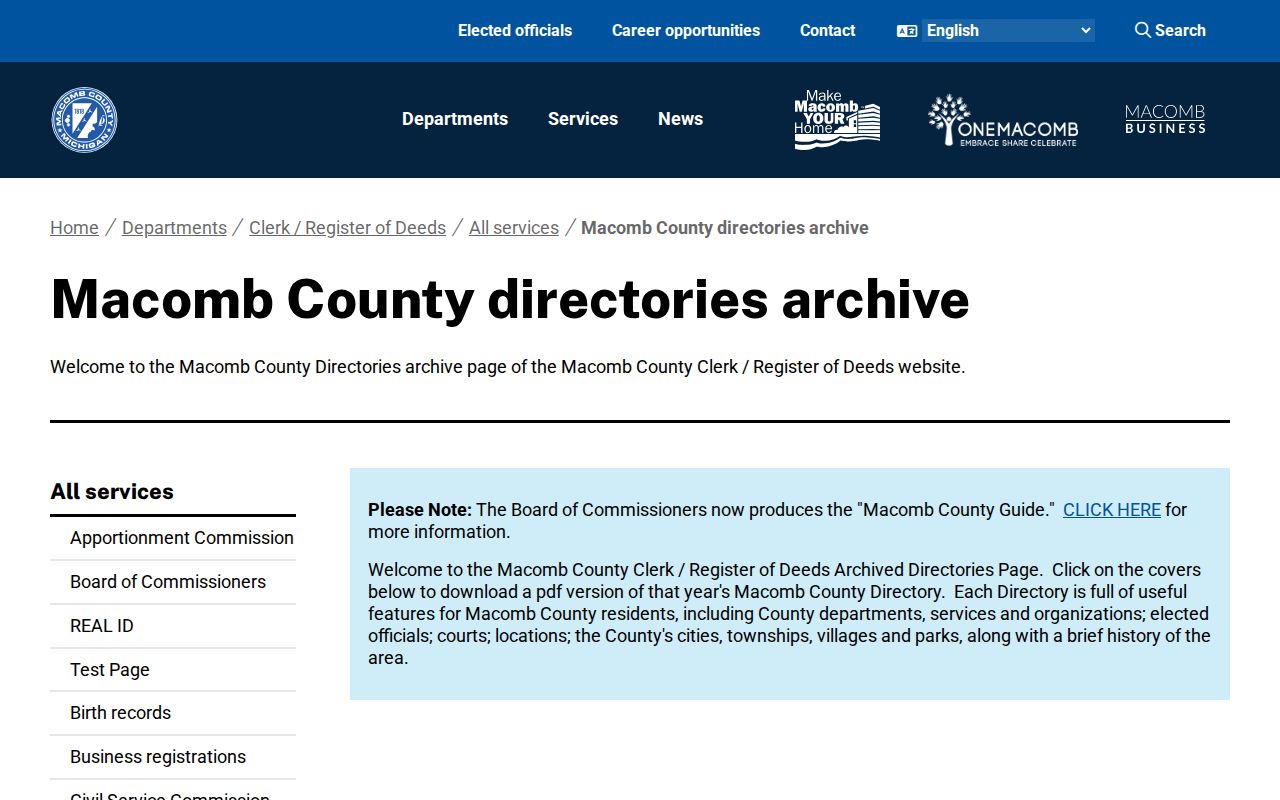
The Macomb County directory archive serves Warren historical research differently than a street directory does. Its volumes catalog courts, county offices, departments, municipalities, and services. That is government context, not people. Editions run from 1947–48 to recent years, with annual or biennial listings reaching from 1951 onward, so the archive can pin down a Warren office name or institutional setting at a chosen point in time. It cannot, however, serve as a reverse directory of Warren residents at their addresses. The archive display makes the distinction plain. What it organizes is a dated civic reference, not a residential roll.
Match a Warren civic book against a Warren residential volume only when each contributes its own dated fact. That habit keeps a county department listing from masquerading as evidence about a household.
Note: The 1963–64 Macomb volume supplies civic context, not a Warren person-by-street entry.
Warren Society Indexes Extend Directories
The Warren Historical & Genealogical Society adds index leads that stretch a directory trail further. Its holdings include Warren census PDFs covering 1830–1870, 1870–1890, and 1900–1920. Macomb death-record material starts in 1867. Cemetery files, church records, diaries, and street or business research round out the menu. Material for Warren Union and St. Clement cemeteries is included too. These reflect genuine Warren preservation work, so they make strong starting points. Still, treat any index as a lead. Check it against an underlying image or a public custodian whenever one exists.
A cemetery or death-index clue can separate two Warren people with similar names. A diary or church reference might explain a local connection. Neither one sustains an unbroken residence history. Keep each source's type, date, and scope clearly apart from the directory entry itself.
Date Warren Directory Evidence
Warren's record trail sits in dated layers. No single continuous directory series ties them together. Treat each Warren book as belonging to its own time frame. Bridge any gaps with sources that carry their own dates. The most recent federal census available is the 1950 count, released under the 72-year rule.
- Late 1800s: Library of Michigan Polk holdings reach this era, but verify a Warren volume before citing it.
- 1947–48: Macomb's documented civic-directory series begins, providing county and municipal context.
- Later decades: Bresser and criss-cross material is commonly later, often from the late 1960s onward, subject to volume confirmation.
- 1950: The latest released federal census supplies a dated household snapshot for comparison.
Preserve old ZIP labels and street spellings exactly as printed. USPS shifted some Warren delivery addresses from 48093 to 48088 in 2001. Swapping a historical postal label for a current one can blur the record being compared.
Trace Warren City Directory Households
Warren family history starts best with a baseline edition, not a forced year-by-year narrative. A name helps. So does an exact Warren street line. Add an edition date and you have a usable opening record. Then check an edition two or three years later if another volume exists. Pair the entries with the nearest released census. Add a deed or parcel result only as its own separately dated Warren property connection. This sequence keeps an old listing from being confused with who occupies a home today.
- Locate the first verified Warren entry and save its edition, page or image, and all printed abbreviations.
- Search a later available Warren edition for the same name, initials, spouse notation, and street form.
- Use the criss-cross section, when present, to read the surrounding dated Warren street line.
- Compare the nearest released Warren census result and note differences without overwriting either source.
- Use a Warren cemetery, death, probate, or deed source only to test a specific transition, retaining its own date.
A vanished name can mean several things. A move, a changed household head, a skipped volume, or a different spelling all produce the same blank. The honest conclusion stays modest: that person simply does not appear in that indexed edition.